
What actually moves the conversion needle in e-commerce AI
A lot of "AI in e-commerce" content reads like a vendor pitch. Here's what we see when we instrument real merchant accounts, look at the funnel, and measure lift.
We've integrated AI features across Shopify Plus, headless Next.js builds, and custom platforms. The features below are sorted by how often they actually show up in the conversion-rate uplift report.
What works
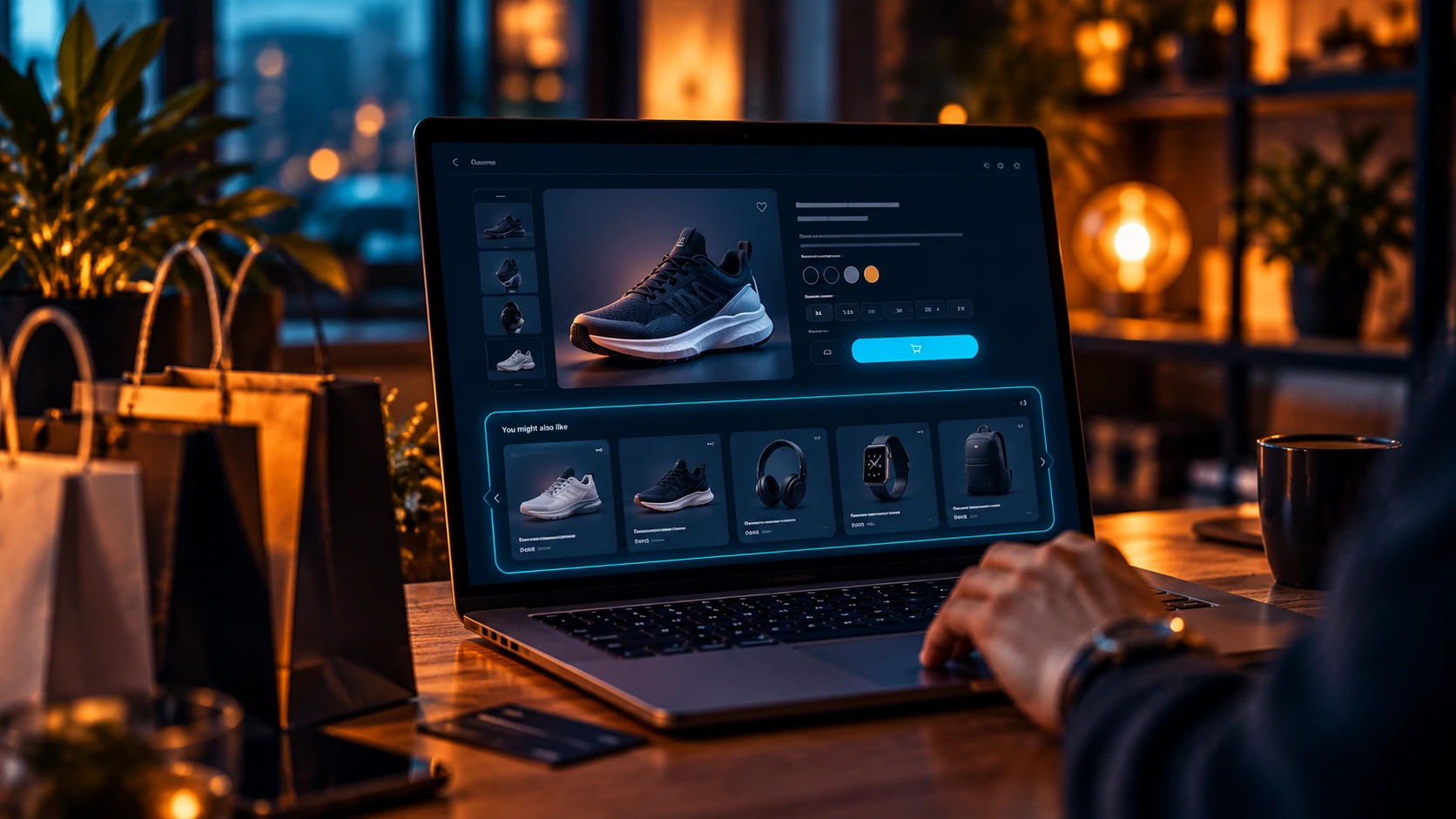
1. Personalized recommendations on PDP and cart. The single highest-ROI AI feature in e-commerce, full stop. A relevance-tuned recommender ("customers who viewed this also bought…") consistently lifts AOV 8–18% and adds 2–5% to overall conversion when placed on product detail pages and cart pages.
What "relevance-tuned" means: not the default Shopify recommendations. You want a model that considers user session behavior, not just SKU similarity. Vendors like Nosto, Klevu, and Algolia Recommend do this well. Building in-house is justified above ~$50M GMV.
2. AI-powered site search. The second-highest ROI feature, especially for catalogs over 1,000 SKUs. Replacing keyword search with a semantic + typo-tolerant search engine typically lifts the conversion rate of users who use search by 30–50%. Since searchers are 2–3x more likely to convert than browsers in the first place, this compounds.
Concrete example: a fashion merchant we worked with replaced their default search with Typesense + a learning-to-rank model. Search-driven revenue went from 14% of total to 22% of total in eight weeks. Nothing else changed on the site.
3. Dynamic pricing — but only in the right context. Useful for: travel, event tickets, perishables, B2B with volume tiers. Useless and brand-damaging for: fashion, beauty, most DTC categories where customers shop the same product repeatedly and notice price changes.
If you do dynamic pricing, the discipline is: rules-based with ML inputs, not pure ML output. The business sets bounds, the model picks within them, and every change is auditable.
4. Customer service deflection. A well-tuned LLM agent can resolve 40–60% of pre-sale questions ("does this come in size 14?", "when will this ship to ZIP 90210?") without human escalation. The economics are clear when you're paying for a 24/7 support team. The implementation is harder than vendors claim — RAG over the product catalog plus a guardrail layer plus human handoff. Budget 6–10 weeks for a proper integration.
What's theatre
Visual search. Sounds great in demos. In production, the conversion rate of "search by photo" users is consistently among the lowest of any traffic segment. Customers don't take photos of products they want to buy; they describe them. Skip this until you've done everything else.
AI-generated product copy. Saves time, but the copy is interchangeable across stores using the same model and prompt, and Google's December 2025 quality update penalized exactly this pattern. Use AI to draft, but have a human edit. Don't ship raw model output.
"AI-powered" upsells that just shuffle the bestsellers. Many platforms slap "AI" on what is effectively a sort-by-revenue widget. Test before you buy: ask the vendor to show you the same product page for ten different user segments and see if anything actually changes.
The implementation order
For most merchants under $20M GMV, this is the order we recommend:
- Site search first. Highest baseline ROI, no model training required if you use a good vendor.
- PDP and cart recommendations second. Compounds with search improvements.
- Email and SMS personalization third. Cheaper than on-site personalization and merchants typically have more data on the email side anyway.
- Customer service automation fourth. Only after you have 50+ tickets/day in stable categories. Below that volume, the operational overhead of maintaining the system exceeds the savings.
- Everything else — dynamic pricing, predictive inventory, fraud scoring — is justified case by case at scale. Don't build it because it sounds modern.
A note on data privacy
The AI features above all run on customer behavior data. As of 2026, EU and California regulations require opt-in consent for personalized recommendations that learn across sessions. If your e-commerce stack doesn't have a consent management layer, fix that before turning on personalization. The fines are not theoretical.
The honest bottom line
For most merchants, AI in 2026 is search, recommendations, and a smart support agent. That's $15k–$50k of integration work and it pays back inside two quarters. Everything else is icing — and a lot of the icing is sugar-free. If you're scoping this for your own store, our e-commerce and AI & machine learning teams plan these integrations together — see how search and recommendations came together for a luxury multi-vendor marketplace in our case study.